Christmas Lights in Portland, 2026: When to Put Them Up, What Installers Charge, How to Hang Them on Gutters and Roofs, and Why They Trip the GFCI in the Rain
Portland's lighting season runs from the first dry weekend in November to the second week of January, and the questions arrive in a predictable order: when, how much, how, what went wrong, and when it comes down. This guide answers them in that order. It is written by a crew that hangs rooflines for a living and cleans the gutters those lights clip to, so the how-to sections are the way we actually do it, and the cost section uses our own numbers. Thanksgiving is Thursday, November 26 this year. Plan backward from it.
Want it handled by a Portland crew? Book Christmas light installation in Portland
October: when should Christmas lights go up in Portland?
The honest Portland answer has two dates, and they are not the same. If you are hiring, the deadline is the end of October. Installers build their November calendar in October, the good weeks fill first, and by Thanksgiving most crews are booked through December. Book in October and you choose your week; book in late November and you take what is left.
If you are hanging them yourself, the date is the first dry weekend in November, whatever the calendar says about Thanksgiving. November is Portland's second-wettest month, roofs and ladders are slick, and the traditional Thanksgiving-weekend hang is the single most likely day of the year for a fall from a ladder. Hang them dry in early November and simply do not turn them on until Thanksgiving evening. Nobody will know, and you will not be on a wet roof on the busiest weekend of the season.
Turn-on is Thanksgiving evening, November 26 this year, and that has been the Portland norm for a long time. Leaving them on through New Year's Day is standard. Take them down in the first two weeks of January, and see the takedown section for how.
The country is drifting earlier, if you want company. National surveys of decorators put about a third of households hanging lights before Thanksgiving, another 40 percent between Thanksgiving and December 1, and around 7 percent lit by the end of October. In Portland the weather pushes the same direction: hang dry, light on Thanksgiving.
Christmas lights before Thanksgiving: is it too early?
Up before Thanksgiving is normal in Portland now, and the weather is the reason. Every installer here hangs in the first three weeks of November because that is when the work can be done safely, and homeowners follow the same logic. The etiquette question is really about turning them on. Hang early, light on Thanksgiving, and you have both.
The one thing that reads as too early is a full display running in the first week of November while the porch still has pumpkins on it. If you want the roofline lit for Halloween as well, that is a different product, a color-changing strand that runs orange and purple in October and switches to warm white in November, and we cover it in the two-holiday lights guide.
How much does it cost to hang Christmas lights in Portland?
Professional Christmas light installation in Portland is priced by the linear foot of roofline, and the range is fairly tight across companies. Our installs run about $10 per foot with commercial-grade LED C9 strands that we supply and own the maintenance on, plus about $3.25 per foot for January takedown. Peaks, second stories, tree wraps and difficult access move the number up, which is why every quote is measured in person.
Worked examples. A single-story ranch with 120 to 180 feet of roofline lands between $1,200 and $1,800 installed, plus $400 to $600 for takedown, so roughly $1,600 to $2,400 the first season. A two-story home with peaks, the garage and a couple of entry accents runs $2,000 to $3,500 installed. Homes that already own strands that test good pay less, because the material and the strand replacement risk come off the price.
Why per-foot quotes range from $2 to $12. The cost guides on Angi and HomeAdvisor put Portland installation at roughly $2 to $6 per foot, and those numbers are real, but they are labor only, hanging strands you bought and will store yourself, often with takedown as a separate charge. Quotes in the $8 to $12 range, ours included, supply commercial-grade strands, keep and test them between seasons, replace failures, and include the service call. Hourly help from a gig site runs $45 an hour and up with no lights, no clips and no insurance certificate. When you compare quotes, compare what is on the house and who owns it in January, not the per-foot number alone.
What a fair quote includes: the strands and clips, layout and colors confirmed before install day, a timer set so the display runs on its own, a call-out if a section fails mid-season, January takedown on a scheduled date, and cleanup both times. What a cheap quote usually leaves out is the takedown, the insurance, and the service call. Ask about all three. The full pricing breakdown, with what installers charge by house type, is in the Portland Christmas light installation guide.
Do installers provide the lights? What to ask before you book
Most professional installers in Portland supply commercial-grade strands, and many will hang strands you already own if they test good. Supplied strands cost more the first year and less every year after, because the installer stores, tests and replaces them. Ask which you are getting and who owns the strands at the end of the season.
This year the math tilts further toward supplied strands. Tariffs on imported holiday lighting, most of it made in China, now run above 30 percent, and retail prices on strands and bulbs have climbed accordingly, with some reports putting the increase well above what stores charged two seasons ago. An installer who already owns commercial strands is, in effect, leasing you lights that were bought before the increase, and you never make the trip to the store. If you do buy your own, buy LED and buy once.
Then ask four more things. Is the company insured for work on your roof, and will they show you the certificate? Is takedown included and scheduled, or a separate call in January? How are the lights attached, because the answer should be clips, never staples or nails? And what happens when a section goes out on December 20, because a strand will fail at some point and you want to know whether a text gets someone back out.
November: how to hang Christmas lights on gutters, with or without gutter guards
Rooflines are hung with clips, not fasteners. The standard all-in-one clip grips the lip of the gutter and holds a C9 socket pointing up or out, one clip per bulb, twelve inches apart. Along a run without a gutter, the same clip slides under the exposed edge of a shingle and holds the bulb at the roof edge. Nothing is stapled, nailed or screwed. Staples cut the insulation and nails put holes in the roof edge.
Gutter guards change which clip, not whether. Guards with a raised front lip take a clip that grips that lip. Flat mesh and screen guards that sit flush with the gutter take a shingle tab slid under the first course of shingles above the gutter, so the bulb sits just above the guard. Foam inserts inside the gutter do not interfere with a lip clip at all. What you do not do is screw into the guard or bend it to make a clip fit; guards are held by a handful of screws and one bent section drains onto the fascia all winter.
One Portland-specific step comes first: clean the gutters. A strand clipped to a gutter full of fir needles is sitting in a wet compost mat for two months, the clips slip on the debris, and in January the takedown is filthy. We clean and flush the gutters the same visit the lights go up, and the pairing is why our lights and gutter calendars run together in November.
How to hang Christmas lights on a roof without gutters, on peaks, ridges and shingles
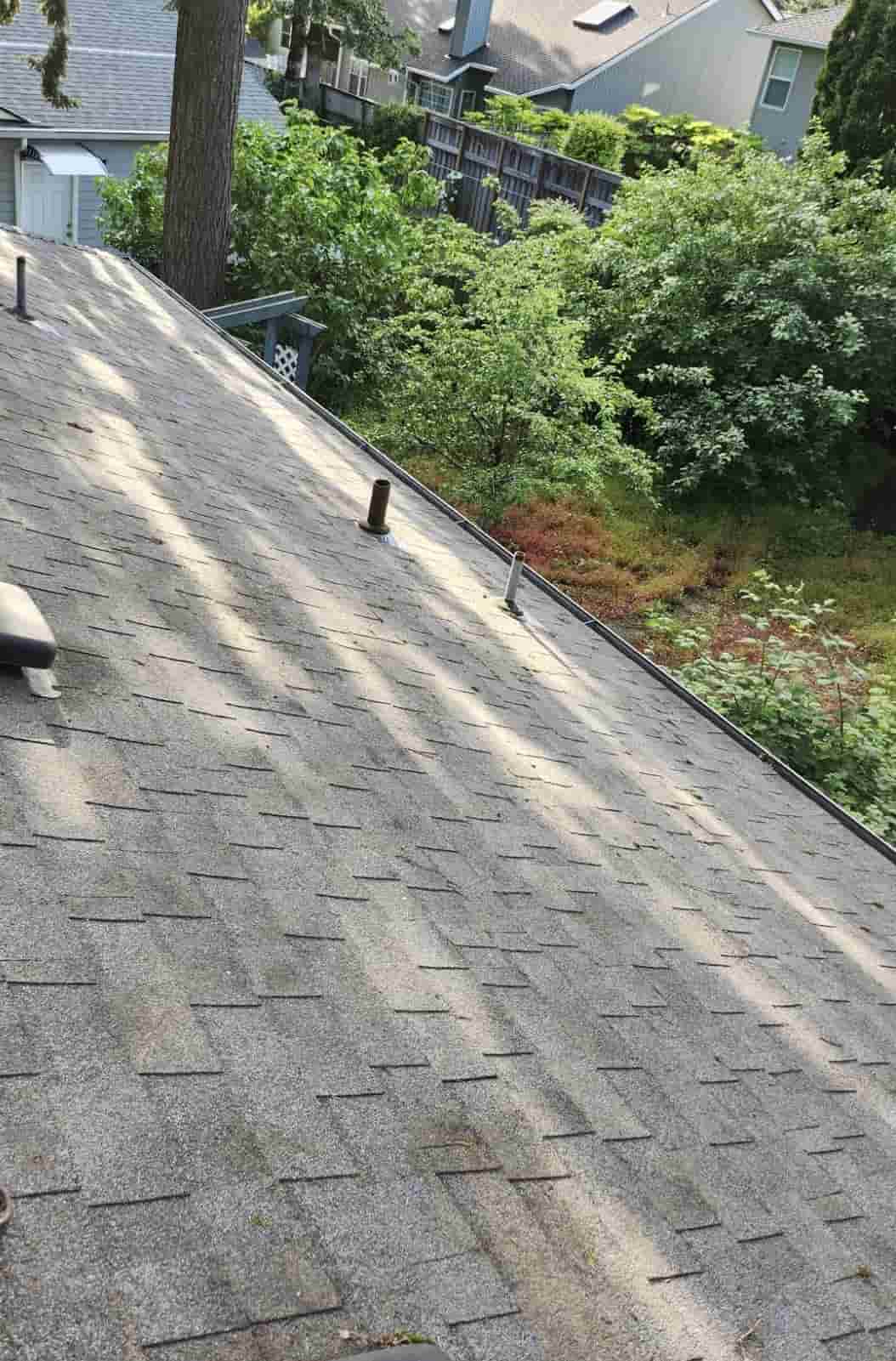
A roof edge without a gutter is a shingle-tab job: the clip slides under the exposed shingle edge and holds the bulb at the drip line. Peaks and rakes, the sloped edges of a gable, take the same tab along the rake, or a ridge clip at the top so the two runs meet cleanly at the point. The strand follows the roofline, not the fascia, and the bulbs all face the same direction, which is the difference between a professional roofline and a wavy one.
Metal roofs take magnetic clips, because standing-seam and corrugated steel are magnetic; aluminum gutters are not, so magnets are a roof trick, not a gutter trick. Tile roofs take a clip made for the tile profile that hooks the tile edge. On any roof, the rule is the same: nothing that penetrates, and no walking on a wet roof to place a clip you could have placed from the ladder.
How to hang Christmas lights without a ladder, and the two-story problem
Single-story rooflines can be done from the ground with a telescoping pole and a hook attachment that places a pre-clipped strand on the gutter lip. Clip the strand on the ground, lift it into place a few feet at a time, and you never climb. It is slower than a ladder and safer than one, especially on the wet lawn that every Portland yard is by November.
Second stories are a different job. There is no pole that safely places a strand on a two-story roofline, and the extension ladder needed to reach it is the one that produces the falls. If the roofline is above the first floor, the safe choices are a stabilized extension ladder on dry, level ground with a second person footing it and the 4-to-1 angle rule, or hiring the roofline out and doing the porch and shrubs yourself. Two-story homes are most of what we install for exactly this reason.
The numbers behind that advice: the Consumer Product Safety Commission counts about 160 holiday-decorating injuries a day in November and December, close to 15,000 emergency-room visits a season, and roughly half are falls, most of those from ladders and roofs while hanging lights outdoors. Almost all of them happen on the same two weekends, Thanksgiving and the one after, on wet ground.
C9 vs C7, LED vs incandescent, warm white vs cool white: what looks right on a Portland house
C9 is the roofline bulb. It is the larger of the two, reads from the end of the street, and spaced a foot apart it gives the clean outline that professional installs are known for. C7 is smaller and suits a small bungalow, a porch rail or a tighter detail, but on a full roofline it reads faint from the street.
LED over incandescent, for a rain city. LED C9 bulbs use a small fraction of the power, run cool, do not blow a circuit when you add the garage, and last many seasons. Incandescent has a warmer glow that some people love, but the bulbs run hot, break easily in a windstorm and limit how many strands you can chain. Modern warm-white LEDs at about 2700K are close enough that most people cannot tell from the street.
Warm white on wood tones and craftsman trim, pure or cool white on modern gray, white and black exteriors, and never both on the same roofline. Warm white is the choice that ages well; it is what most of the roofline installs in Lake Oswego, West Linn and the older SE Portland neighborhoods use, and it is what we recommend when someone asks. Colored bulbs, red and green or multicolor, look best as a full run rather than a mix with white.
Two things are moving this year. Installers across the country report warm and vintage white overtaking multicolor on upscale homes, with clean architectural rooflines and one fully wrapped feature tree instead of a busy yard. And permanent lighting is the fastest-growing corner of the industry: professional track systems at $18 to $35 per foot, and consumer kits from brands like Govee that clip under the eave for a few hundred dollars per 100 feet and run from an app. The kits are real and they are cheap, but they are a DIY ladder job with consumer-grade output, and the track shows in daylight. Permanent tracks are licensed contractor work in Oregon and not something we install; the permanent-versus-seasonal guide walks through all three options with the numbers and how to vet a permanent installer.
How many Christmas lights can you connect together?
Incandescent mini strings carry the old rule: no more than three end to end, because the plug fuse is sized for it. Incandescent C9 strands draw about seven watts per bulb, so a 25-bulb strand is about 175 watts and a 15-amp circuit safely carries about eight of them with nothing else running. LED C9 strands draw a watt or less per bulb, so a whole roofline can run from one outlet. Check the tag on the strand for the maximum run, and give the display its own outdoor GFCI outlet rather than sharing the one the refrigerator in the garage is on.
December: are outdoor Christmas lights safe in the rain, and why do they trip the GFCI?
Outdoor-rated lights are made to be rained on. The bulbs and the strand itself are fine. What is not fine is water sitting inside a plug connection, and that is the entire story of Portland's December GFCI trips. A connection lying on the wet lawn or the wet patio fills with water, the water bridges the hot to ground, and the outlet trips exactly as it is designed to. Nothing is broken. The outlet is telling you where the water is.
The fix is mechanical. Get every connection off the ground: zip-tie the joins to the gutter or the strand, or hang them on a clip. Point the female ends down so water runs out instead of in. Use outdoor-rated cords, and put the cord-to-cord joins inside a weatherproof cord cover or a plastic box with the ends taped. A little dielectric grease in the plug keeps water out of the pins. And never bypass the GFCI with an adapter; it is the only thing between a wet strand and a shock. A display that trips every storm has one connection in a puddle, and it is usually the extension cord join behind the shrubs.
If the breaker trips rather than the GFCI, that is load, not water: too many incandescent strands on one circuit, or the display sharing a circuit with a space heater. Move the display to its own outlet or switch to LED.
Plan for water this winter, not ice. NOAA puts the odds of a very strong El Nino for the 2026 to 2027 winter above 90 percent, and for the Portland side of the Cascades that historically means a warmer, wetter December with heavy rain and little lowland snow. More workable install days in November, and a display that will be rained on for six weeks straight. Every connection off the ground.
Half of my Christmas lights aren't working: the five-minute diagnosis
On an incandescent mini string, the bulbs are wired in series in sections of 35 to 50, so one bulb that has come loose or burned out with a failed shunt takes its whole section down while the rest stays lit. Look for the dark section, check for a bulb that is loose or has a cracked base, and replace it. If both halves are out, check the small fuse in the plug; it pulls out with a fingernail and the spare is usually in the plug too. A $15 light tester finds the dead bulb in a minute.
LED strings fail differently. A single bad LED or a corroded socket takes a section out, and the fix is the same: find the first dark bulb, reseat or replace it. C9 strands, incandescent or LED, are wired in parallel, so a dead bulb is just a dead bulb; replace it and move on. Flickering on a long run is usually a loose bulb or a connection that is wet; a whole run flickering at once is voltage drop from too many strands chained, so split the run and feed it from two outlets.
Where Portland goes to see Christmas lights, and what the pros do differently
Most of the December searches for Christmas lights in Portland are not about hanging them. They are people looking for Peacock Lane, the SE Portland street that has lit every house since 1932 and runs free, car-free on its busiest nights, in the second half of December. ZooLights at the Oregon Zoo, a million and a half lights along the forest paths with timed tickets from late November into early January. The Christmas Ships, a fleet of about 60 decorated boats that has paraded the Willamette and Columbia since 1954, watched for free from the riverbanks in the first half of December. Winter Wonderland, the drive-through show at Portland International Raceway, and the Christmas Festival of Lights at The Grotto. Dates are announced each October, so check the venue before you go.
If you want your own roofline to read like those displays from the street, the technique is the same one the pros use on houses: C9 bulbs spaced a foot apart, one color temperature for the whole roofline, every bulb facing the same way, the peaks outlined and the porch and one feature tree lit, and everything else left dark. Restraint is what makes a house look professionally lit. The busy yard is what makes it look like a hardware-store aisle.
January: when to take down Christmas lights, and how to store them
Down by the middle of January is the Portland convention; some households wait for Epiphany on January 6 and some take them down New Year's weekend. Weather matters more than the date. Take them down on a dry, calm day, never in a windstorm and never with ice on the roof edge, and if the only dry day is in late January, wait for it.
Store them so next year's install takes half the time. Unclip the strand, leave the clips on, wrap each run around a piece of cardboard or a reel, and label it by the side of the house it came from: front roofline, garage, left peak. Test each run before it goes in the box, so the dead strand gets replaced in January when you have time rather than in November when you do not. Keep the box dry. A strand that spent the year in a damp garage corner is the one that trips the GFCI next December.
If an installer hung them, takedown is scheduled at the install and included in the quote. Ours comes down in January on the date we agreed, the strands go into our storage, tested, and the roofline is ready to rehang the following November without a new measurement.
Or have the roofline done
Three ways to light the house this season, measured from your roofline and priced before anything is scheduled. October bookings pick their November week.
Warm white, up by Thanksgiving
Commercial C9 roofline install with a timer, takedown in January, a text if a section fails.
Priced by the rooflineGet a lights quoteHalloween to Christmas
Color-changing C9 strand with a remote, hung once in the fall, switched November 1.
$1,000 to $1,500 typicalSee two-holiday lightsGutters cleaned first
Every downspout flushed before the clips go on, the same visit or the week before.
Fall gutter visitGet a gutter quoteWant the full pricing breakdown by house type? Read the Portland Christmas light installation guide
Questions homeowners ask
When should I put up Christmas lights in Portland?
Book an installer by the end of October; installs run the first three weeks of November. If you hang your own, use the first dry weekend in November and turn them on Thanksgiving evening, November 26 this year.
How much does it cost to have Christmas lights installed in Portland?
About $10 per roofline foot installed with commercial-grade lights, plus about $3.25 per foot for January takedown. A single-story home lands near $1,600 to $2,400 the first season; two-story homes with peaks run $2,000 to $3,500 installed.
Is it too early to put Christmas lights up before Thanksgiving?
Not in Portland. Early November is when the weather allows safe hanging, so hang them early and turn them on Thanksgiving evening.
Can you hang Christmas lights on gutters with gutter guards?
Yes. Guards with a raised lip take a lip clip; flat mesh guards take a shingle tab slid under the first course of shingles so the bulb sits above the guard. Never screw into or bend the guard.
How do you hang Christmas lights on a roof without gutters?
With shingle tabs that slide under the exposed shingle edge and hold the bulb at the drip line, ridge clips at peaks, magnetic clips on steel roofs and profile clips on tile. Nothing is stapled or nailed.
Why do my Christmas lights keep tripping the GFCI when it rains?
Water is sitting in a plug connection, usually one lying on the ground. Get every connection off the ground and facing down, cover the cord joins, and never bypass the GFCI.
Why is half of my string of Christmas lights not working?
On incandescent minis, one dead or loose bulb takes its series section out; find the first dark bulb and replace it, and check the plug fuse if the whole string is dark. LEDs fail at a bad bulb or socket the same way. C9 strands are parallel, so a dead bulb is only a dead bulb.
When should Christmas lights come down?
By mid-January, on a dry and calm day. Wrap each run on cardboard, label it by the side of the house, test it, and store it dry.
How much do Christmas light installers charge per foot?
Roughly $2 to $6 per foot for labor only, hanging strands you own, and $8 to $12 per foot with commercial-grade strands supplied, stored, tested and serviced by the installer. Compare what is on the house and who owns it in January, not the per-foot number alone.
Are DIY permanent Christmas lights like Govee worth it?
For a few hundred dollars per 100 feet they are the cheapest way to get app-controlled color on the eave, but they are a ladder job you do yourself, the output is consumer grade, and the track shows in daylight. Professional track systems run $18 to $35 per foot; seasonal installs leave nothing on the house in January.
Where can I see Christmas lights in Portland?
Peacock Lane in SE Portland in the second half of December, ZooLights at the Oregon Zoo from late November, the Christmas Ships on the Willamette and Columbia in early December, Winter Wonderland at Portland International Raceway, and the Christmas Festival of Lights at The Grotto. Dates are announced each October.